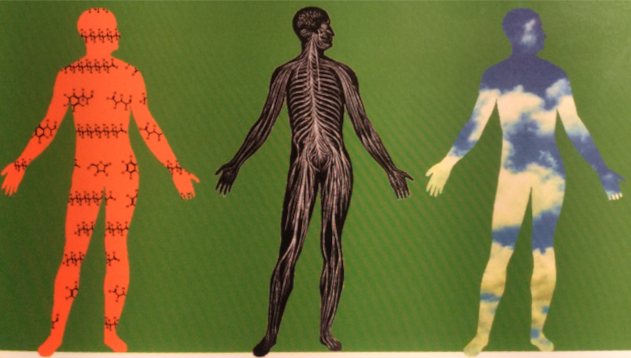
Bicycles, the gut microbiome and antidepressants.
The writer and philosopher, Alan Watts, told an enlightening story. A guard saw a boy riding a bicycle across an isolated spot on the border. This boy is up to no good, the guard thought. He stopped the boy and searched him, but found nothing and let him go. The next week, he again saw the boy cross the border, but with a bigger, better bicycle. He must be up to something! he thought. He searched the boy then searched every possible hiding place on the bicycle but found nothing and let him go. The following week, the boy came with another even more expensive bicycle. He can’t possibly have money for a bicycle like that without committing some crime! This boy must be smuggling something! He searched the boy and tore that bicycle apart looking for contraband. Much to his consternation, he again found nothing and let the boy go. This same thing went on month after month. Years later, the border guard was in town and again saw the older, now very well-dressed boy. He could not help but approach him. “I am old and retired,” the guard said. “I have no power to arrest you. So please, tell me. What were you smuggling all those years?” The boy smiled and said, “Bicycles!”
We often have set ideas about what must be the case that leads us to overlook other possibilities. This has long been the case with notions about how antidepressants work. Antidepressants were discovered quite by accident in the 1950’s when the drug iproniazid was being used to treat tuberculosis. “Patients were dancing in the hallways!” one incredulous doctor reported. Initial studies suggested that the drugs likely acted by increasing levels of the neurotransmitters serotonin, norepinephrine and dopamine in the brain. When the effectiveness of the selective serotonin reuptake inhibitors, the SSRIs, was discovered, it came to be thought that antidepressants acted primarily by increasing serotonin and that, in turn, Major Depression was due to “not enough serotonin.”
Over the last few decades, it has become clear that the, “Not enough serotonin” explanation of Major Depression is woefully inadequate. First, there is no evidence that levels of serotonin are low in the brains of people who are depressed. Rather, it appears that the problem is not how much serotonin is in the brain, but in how the brain responds to serotonin. It has further been learned that there are many other physiological and biochemical abnormalities in the brains of people suffering Major Depression. Stress, inflammation, oxidative damage, abnormal insulin responses, mitochondrial aberrations, and failures in maintaining levels of neuron growth factors all play important roles in the development of Major Depression, including changing how the brain responds to its various neurotransmitters. At the same time, it has been learned that SSRIs do much more than simply increasing serotonin levels. They also exert anti-inflammatory effects, increase the production of neuron growth factors such as Brain Derived Neurotrophic factor, affect insulin sensitivity, fight oxidative stress, and improve mitochondrial function by a variety of mechanisms some of which have little or nothing to do with serotonin.
One of the more recent discoveries is that people suffering Major Depression have abnormalities in the varieties and numbers of bacteria in the gut. That is, they have an abnormal gut microbiome. There is often an outgrowth of pro-inflammatory bacteria at the expense of the beneficial anti-inflammatory species. When the balance shifts, the inflamed gut releases a variety of inflammatory signals that reach the brain and disrupt normal function. Toxins from bacteria themselves further contribute to abnormal function. Resulting aberrant signaling from the vagus nerve in the gut to the brain likely also contribute. At the same time these harmful bacteria can prevent beneficial bacteria from contributing substances that support brain function.
These interactions between the brain and the gut microbiome are reflected in the fact that antibiotic treatments can sometimes precipitate Major Depression. A single exposure is associated with a higher risk for depression, and this risk increases with repeated exposures. One recent study even suggested that exposure to antibiotics in early life can be associated with an increased risk for later developing a psychiatric illness. It remained to be determined whether this was due to the antibiotics themselves, to the infections that were being treated, or both. Nonetheless, animal studies have shown that gut bacteria do play a role in how a young animal will respond to future adversities. When rodents are separated from their mothers soon after birth, the trauma causes lifelong hypersensitivity to stress. However, in mice drawn from laboratory-raised colonies whose guts are free of bacteria, this does not occur.
The complex roles of the gut microbiome in mood are further seen in evidence that antidepressants interact with gut bacteria. In a recent study of depressed elderly patients, it was found that the presence of certain gut bacteria could be used to predict the response to the antidepressant drug, levomilacipran. Similarly, in a study on the effects of the antidepressant escitalopram, people that responded to treatment began with more complex and well-organized microbiomes than did those who did not respond. It is not clear how baseline gut bacteria can predict the effectiveness of an antidepressant. However, numerous studies have shown that antidepressants, including SSRIs, tricyclic antidepressants, and monoamine oxidase inhibitors, possess antimicrobial properties and can directly reshape gut bacterial communities. Thus, some of the effects of antidepressants may be through actions as antibiotics that normalize the gut microbiome. In turn, a normal gut microbiome may be necessary for antidepressants to work in the brain. Like the boy and his bicycles, the truth about antidepressant action, or at least part of it, may be hiding in plain sight.
About the Author
Scott Mendelson M.D., Ph.D.
Dr. Scott D. Mendelson earned a Ph.D. in Biopsychology at the University of British Columbia and performed post-doctoral research in Dr. Bruce McEwen's Laboratory of Neuroendocrinology at The Rockefeller University. He subsequently earned an M.D. degree at the University of Illinois College of Medicine and served his residency in Psychiatry at UVA Health University Medical Center. He is currently retired after 26 years of practicing inpatient and outpatient psychiatry.
Books by Dr. Mendelson include:
Metabolic Syndrome and Psychiatric Illness: Interactions, Pathophysiology, Assessment and Treatment. Amsterdam ; Boston : Elsevier, 2008
Beyond Alzheimer's: How to Avoid the Modern Epidemic of Dementia. Plymouth; M. Evans, 2009
Herbal Treatment of Major Depression: Scientific Basis and Practical Use. Boca Raton; CRC Press, 2019
Herbal Treatment of Anxiety: Clinical studies in Western, Chinese and Ayurvedic Traditions. Boca Raton; CRC Press, 2022
Dr. Mendelson may be reached at: s_mendelson@msn.com
Leave a ReplyCancel reply